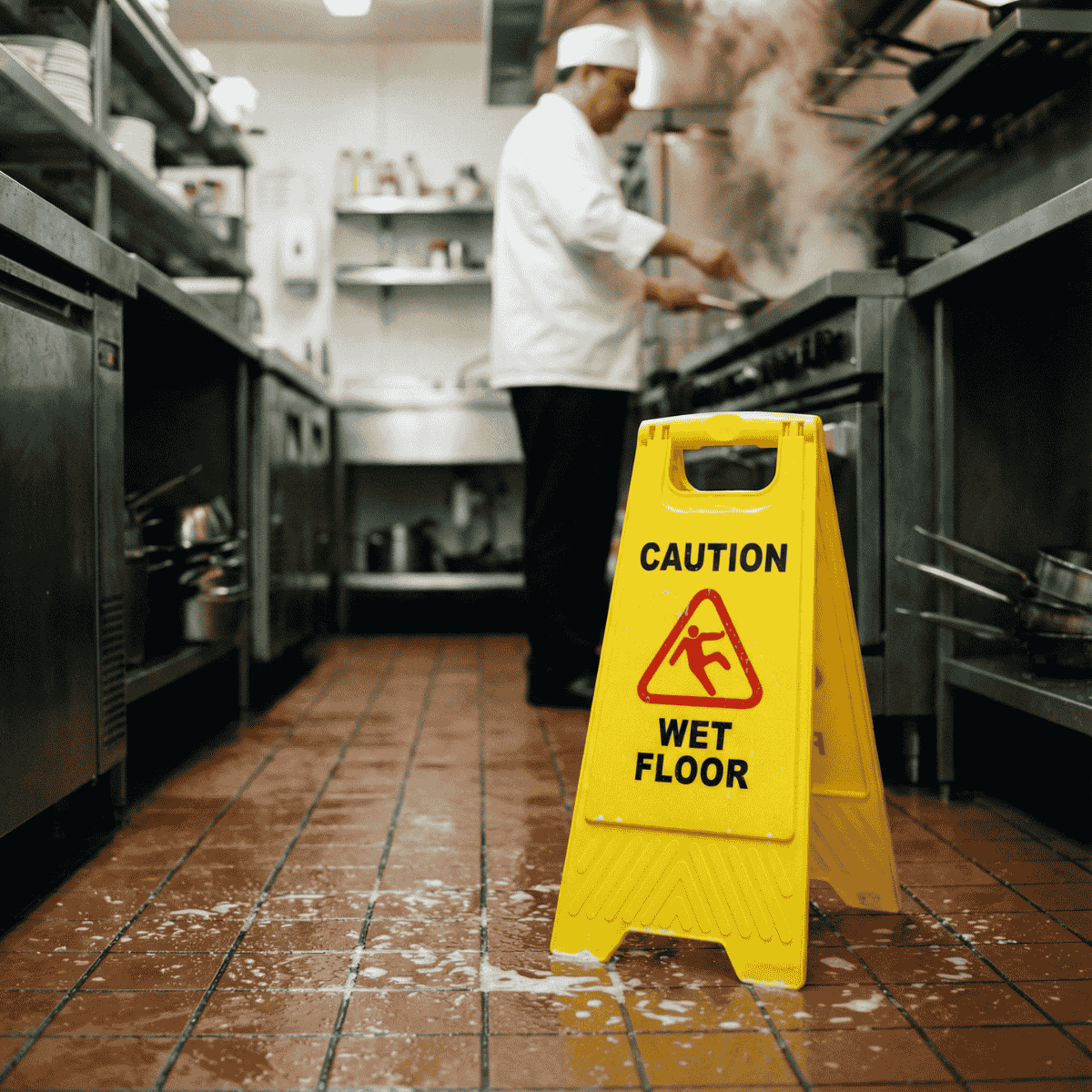
Slip and fall claims are the most common premises liability actions filed against restaurants. However, proving—or defending against—allegations of negligence often requires more than just a witness statement saying “the floor was wet.”
As a restaurant slip and fall expert, I help attorneys move beyond anecdotal evidence by applying scientific standards and industry-accepted protocols to determine if a specific condition constituted a breach of the standard of care.
Here is how industry standards impact the outcome of your litigation.
1. The “Reasonable Care” Threshold
Restaurants are not insurers of their patrons’ safety; they are only required to exercise “reasonable care.” In litigation, the definition of “reasonable” is often anchored in specific industry standards, such as:
- ANSI/NFSI B101.1 & B101.3: Standards for measuring the wet static coefficient of friction (SCOF) and dynamic coefficient of friction (DCOF) of hard-surface walkways.
- ASTM Standards: Protocols for safe walking surfaces and bathing facilities.
If a restaurant’s flooring fails to meet the minimum traction thresholds outlined in these standards (typically a DCOF of 0.42 or higher under ANSI A137.1), it provides powerful objective evidence of a dangerous condition.
2. Constructive Notice and Inspection Logs
A critical defense in slip and fall cases is lack of notice. “We didn’t know the spill was there.” However, operational standards dictate that restaurants must maintain active vigilance.
- The “Sweep Log” Defense: Does the restaurant have a documented “sweep log” or bathroom inspection sheet?
- The 15-Minute Rule: In high-traffic fast-food environments, industry custom often dictates inspections every 15 to 30 minutes.
- Missing Evidence: If a restaurant claims they inspect regularly but cannot produce a log, or if the log shows “perfect” checks every hour on the hour (suggesting “pencil whipping”), credibility crumbles.
3. Floor Cleaning Protocols: A Hidden Hazard
Ironically, many falls are caused by the cleaning process itself. Using the wrong enzymatic cleaner on a quarry tile floor can break down the tile’s grit, turning a safe floor into an ice rink over time. As an expert, I audit the Chemical Data Sheets (SDS) and maintenance logs to see if the restaurant’s own cleaning procedures created the hazard.
The Role of the Expert Witness
Whether I am retained by the plaintiff or the defense, my role is to objectively answer:
- Was the flooring material suitable for a commercial kitchen or dining room?
- Were mats properly placed at transition areas (e.g., kitchen to dining room)?
- Did the staff follow established protocols for spill response?
Key Takeaway: In slip and fall litigation, the “hazard” isn’t always the spill itself—it’s often the operational failure to detect, prevent, or properly clean it.