
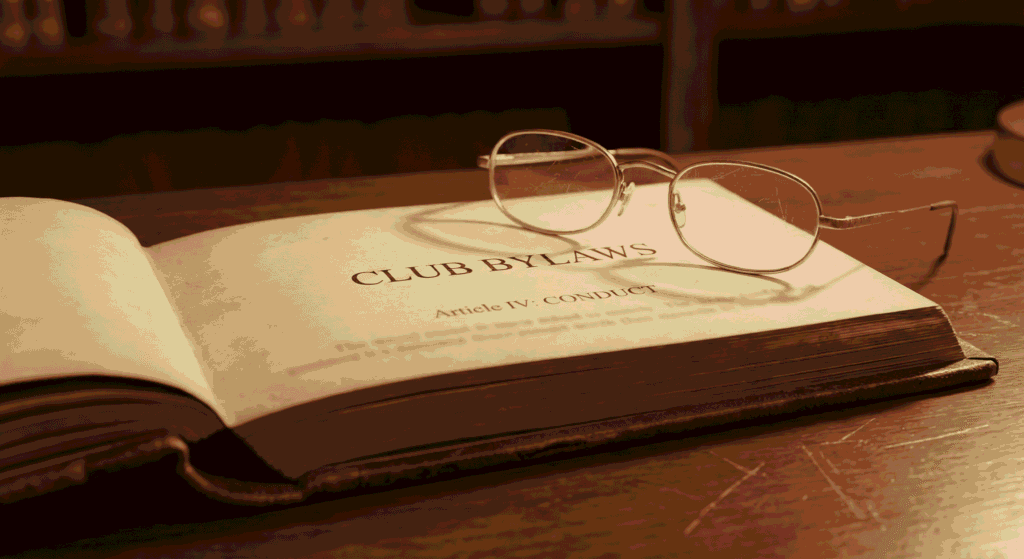
In standard dram shop cases, we measure a venue’s actions against state liquor laws. In private club litigation, there is a second, often more damaging yardstick: the club’s own bylaws.
Private clubs pride themselves on high standards of conduct, which are codified in extensive rulebooks, house rules, and membership agreements. When a club fails to enforce the strict standards it wrote for itself, that gap between written policy and actual practice becomes powerful evidence of negligence.
Here is how we utilize club bylaws to build a case.
1. The “Standard of Care” Gap
Most private clubs have bylaws that explicitly prohibit “unbecoming conduct,” “public intoxication,” or “behavior detrimental to the club.” These rules often set a higher standard of care than state law requires.
In litigation, we compare these written promises to the surveillance footage or incident logs. If a club’s bylaws mandate the immediate removal of a disorderly member, but staff allowed that member to remain on premises for another hour (resulting in an injury), the club has voluntarily violated its own safety protocol. They cannot claim the behavior was “unforeseeable” when their own rules explicitly anticipated it.
2. Missing Disciplinary Trails
Club bylaws almost always outline a specific process for handling violations: an incident report, a review by the House Committee, and a hearing.
We frequently find that clubs skip these steps for influential members. When we audit a club’s records and find no “incident report” for a major altercation—despite bylaws requiring one—it suggests a pattern of concealment or administrative negligence. A missing paper trail in a venue that claims to be highly regulated is often more damaging than the incident itself.
3. Board of Directors & Officer Liability
Unlike a corporate chain restaurant, a private club is governed by a Board of Directors. These individuals have a fiduciary duty to protect the club’s assets—which includes shielding the club from lawsuits.
If the Board was aware of a pattern of dangerous over-service (e.g., through meeting minutes or manager complaints) and failed to act, liability can sometimes extend beyond the club entity to the governance structure itself. We analyze Board meeting minutes to determine if the Directors knowingly ignored safety audits to preserve revenue or member relationships.
Case Takeaway: A club’s rulebook is often the plaintiff’s best weapon. By highlighting the disparity between the club’s “on-paper” prestige and its operational reality, we demonstrate that the injury wasn’t an accident—it was a failure of governance.